Digitalizing a car service: from traditional management to smart systems
What is digitalization, how does it work and what does it give the owner of a car service? A practical guide to moving from notebooks and memory to one digital system.
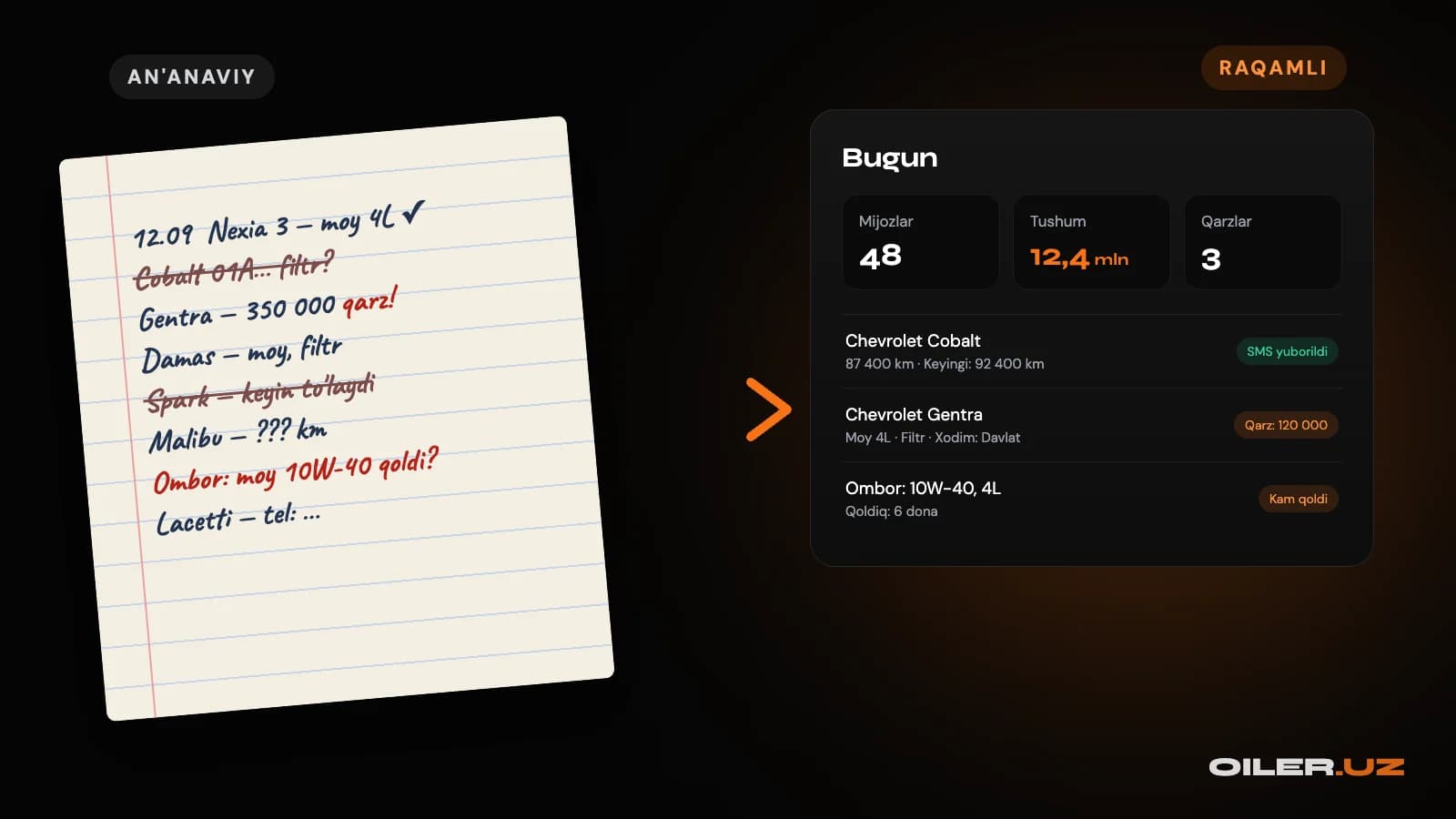
The service opens in the morning. The first customer pulls up in a Cobalt and asks: "Which oil did you use last time?" The mechanic flips through the notebook, can't find it, and starts scrolling old Telegram messages. A second customer walks in, and nobody wrote down whose debt was left at the till yesterday. Counting the day's revenue takes an hour in the evening, and the oil left in stock never matches the notebook.
This picture is familiar to many car services and oil change shops in Uzbekistan. The problem is not the mechanics, it is the way the business is run. In this article we look at what digitalizing a car service means, how it works in practice and what concrete benefits it brings to the owner.
What is digitalization?
Digitalization is not just putting a computer in the service. It means keeping all of the service's important information in one system:
- customers and their cars: plate number, model, phone;
- service history: when, which oil, at what mileage, who did the work;
- stock: oil, filters and other goods on hand;
- till and debts: who paid how much, who owes how much;
- staff: who did which job, and payroll.
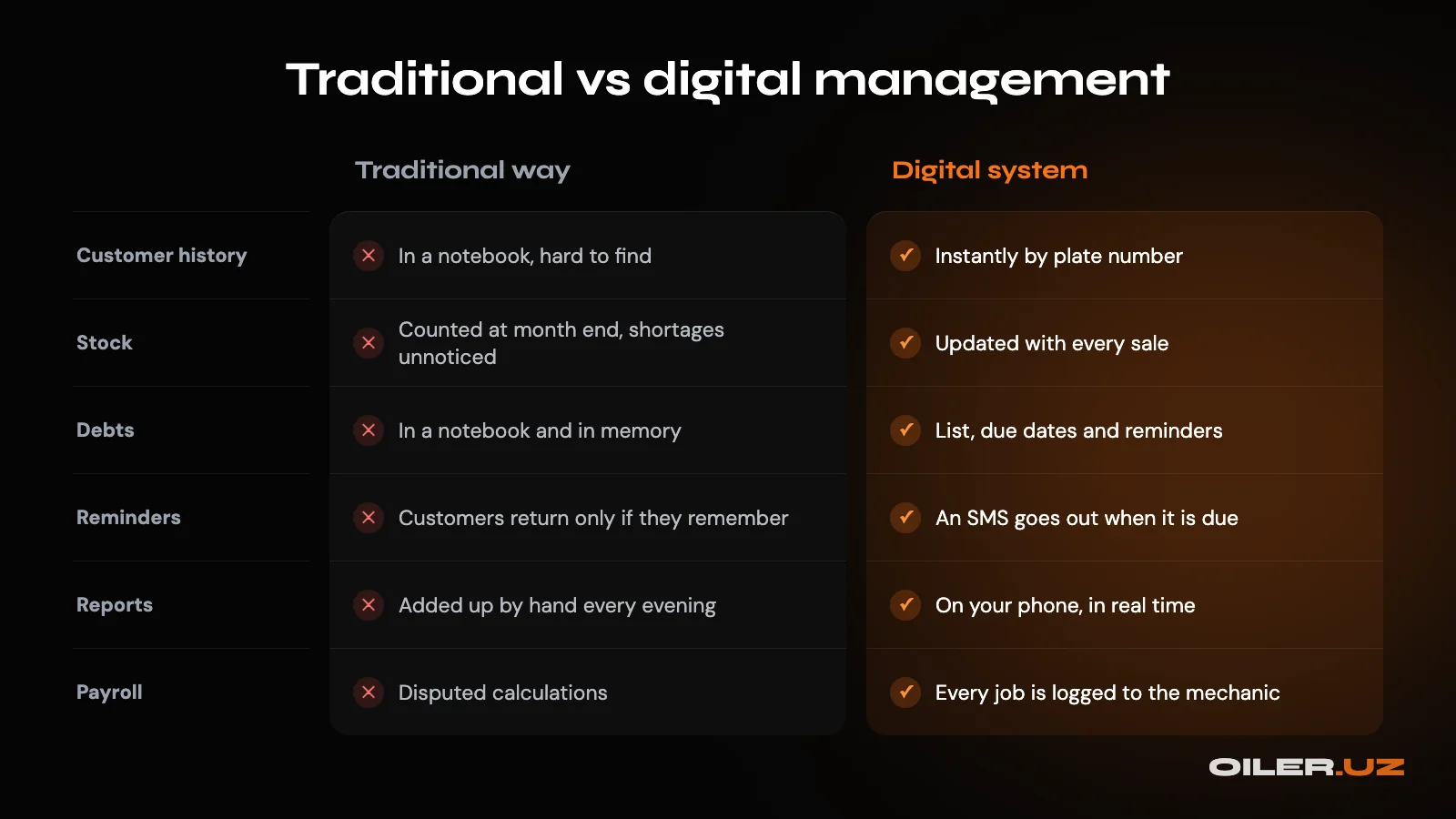
In the traditional approach this information is scattered between a notebook, an Excel file, a Telegram chat and the mechanic's memory. In a digital system it is stored in one place and linked together. When a service is logged for a customer, the stock, the till and the mechanic's pay all update on their own.
How does a digital system work?
It is easiest to follow a single customer.
- The customer arrives. The administrator enters the plate number and the system finds the customer at once. A new customer is added in a minute.
- The history opens. The screen shows past visits: which oil was used, at what mileage, which filters were changed. You answer "what did you use last time?" without flipping through a notebook.
- The service is logged. The mechanic picks the oil, the filter and the price. Who did the job is recorded here too.
- Stock and till update. The oil sold is taken out of stock automatically. If the customer pays, the money goes to the till; if not, the amount is added to the list of debts.
- A QR sticker goes on. A sticker with the next change mileage and the service's phone number goes on the windshield. The customer can scan it to see the full service history.
- A reminder goes out. When the next change is due, the customer gets an SMS automatically, and comes back to you rather than to another service.
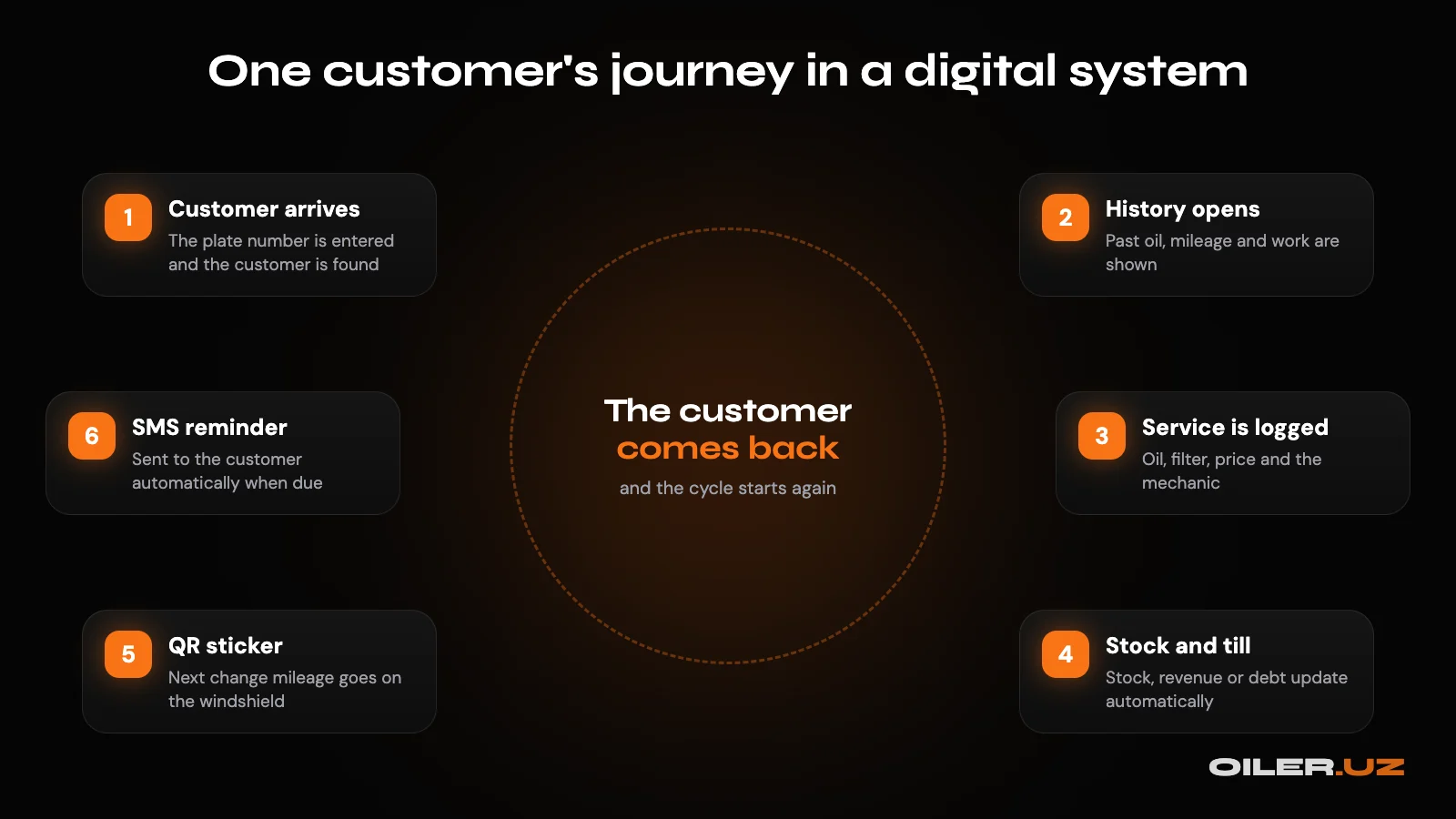
This cycle repeats dozens of times a day, and the database grows every time. A few months in, your service "remembers" every customer, their car and their habits.
What does the owner of a car service gain?
1. Customers come back
An oil change is a repeat service: every customer should return every few months. But customers often forget when it is due and drive into the first service they see. A timely SMS reminder and the sticker on the windshield bring them back to you specifically. And a returning customer is the cheapest kind: they come without any advertising spend.
2. Stock is under control
When every sale is taken out of stock automatically, the count is always accurate. You see in advance which oil is running low, so you never have to tell a customer it is sold out. Missing goods also show up quickly: if the system and the shelf disagree, you notice right away, not at the end of the month.
3. Debts are not forgotten
Customers who will "pay later" get lost in a notebook. In the system every debt is recorded with the amount, the date and the customer's phone number. You see who owes what at a glance and can send a reminder. Often a single debt that was not forgotten pays for the system.
4. Staff pay is transparent
Every job is logged to the mechanic who did it. At the end of the month there are no arguments about pay: the report shows how many cars each person serviced and how much they earned.
5. You run the service remotely
You can see today's revenue, customer count and debts on your phone without being at the service. This matters most if you plan a second branch: without a system, every new branch needs the owner on site.
6. Customers trust you more
When a customer is shown their car's full service history, they trust the service more. With the QR sticker they can check which oil went in and when the next change is due. That sets a professional service apart from an ordinary shop.
7. Decisions are based on numbers, not guesses
Which oil sells best, which days are busiest, what the average ticket is: it is all in the reports. With them you decide what to stock more of, when to bring in an extra mechanic and how to set prices.
Worked example: how much do reminders bring in?
You can estimate the benefit of digitalization yourself. The figures below are an example only; replace them with your own service's numbers.
Say your service does 400 oil changes a month, and the average ticket, including oil, filter and labour, is 350,000 UZS. If reminders bring back just 5% of those customers who would otherwise have gone elsewhere, that is 20 extra visits a month.
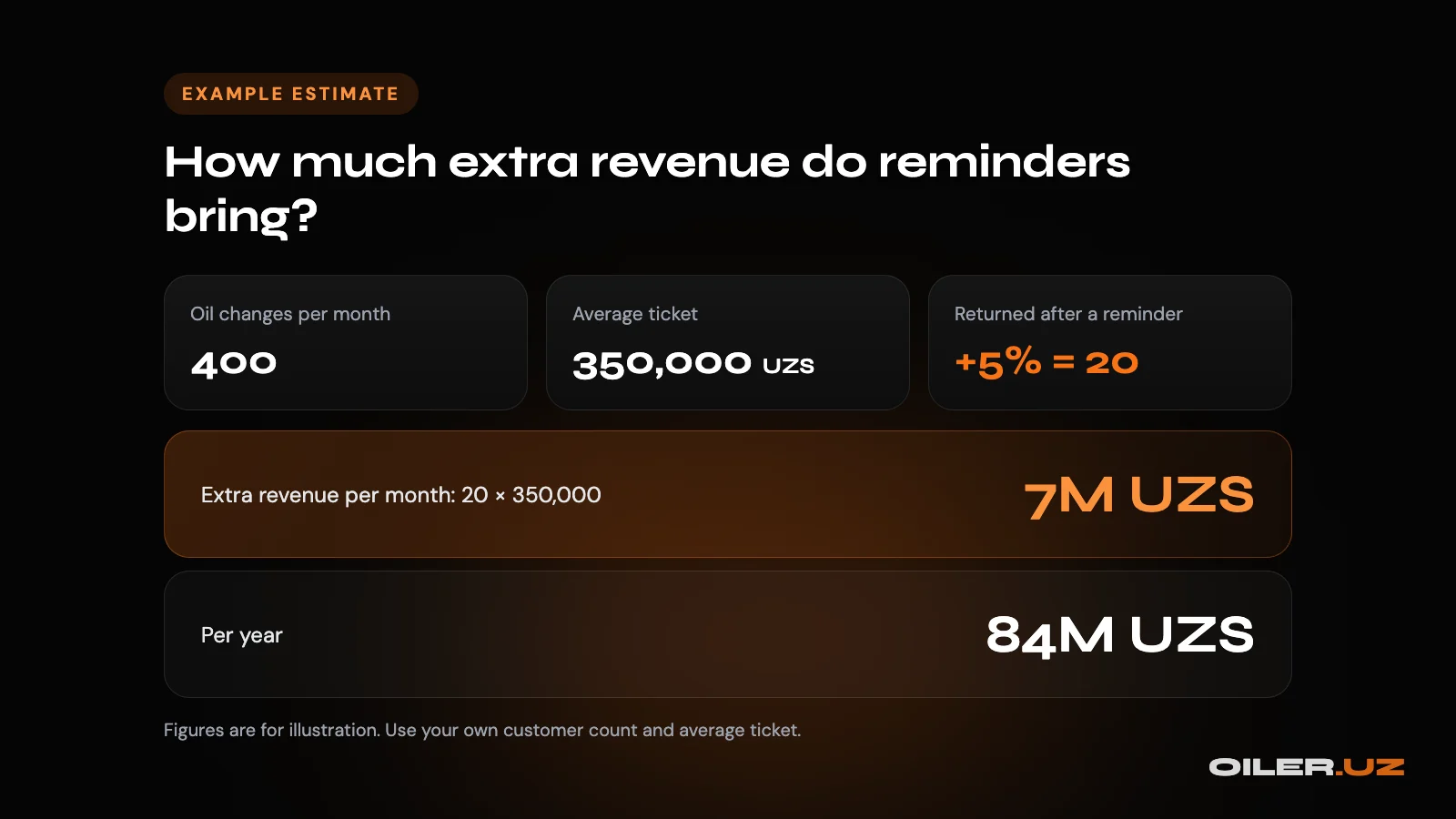
| Metric | Value |
|---|---|
| Oil changes per month | 400 |
| Average ticket | 350,000 UZS |
| Returned after a reminder | 5% = 20 |
| Extra revenue per month | 7,000,000 UZS |
| Extra revenue per year | 84,000,000 UZS |
This does not yet include smaller stock losses, debts that are not forgotten and the time saved on bookkeeping.
Where to start?
The switch does not happen in a day, but it can be completed in a few weeks. Here is a practical plan:
- Write down your current process. What happens from the moment a customer arrives until they leave, and where is each piece of information recorded? Mark the places that lose the most time and money.
- Enter your customer base. Move customers and cars from the notebook or Excel into the system. Many systems do this through an import.
- Count and enter your stock. Do one accurate stocktake. From then on the system keeps the count.
- Train your staff. Run the system and the notebook side by side for the first week so the mechanics get used to the new way.
- Turn on reminders and reports. After a month, compare revenue, returning customers and debts with the month before.
Frequently asked questions
My staff are not good with computers. Will they manage? Modern systems work on a phone and have a simple interface. One or two days of training is usually enough. OILER.UZ trains all of your staff for free.
Will we lose our old records? No. Customers and stock levels can be moved into the system. OILER.UZ does the initial data migration for free.
Does a small service need this? Yes, a small one especially. In a team of two or three, every lost customer and forgotten debt has a noticeable effect on revenue. The system also prepares the business to grow.
Conclusion
Digitalizing a car service is not an expensive, complicated project; it is putting the work in order. Instead of a notebook, Excel and memory, one system brings customers back, keeps stock and debts under control and lets the owner run the business from anywhere.
You do not need a big decision to start: try one system and compare the numbers after a month. You can try OILER.UZ free for 7 days. To tell customers exactly how much oil their car takes, use our oil capacity guide, and you can see the services already running on OILER.UZ on the map.